White Paper Summary
Most enterprise automation doesn't fail because the automation is bad. It fails because every team automates its own slice of the process and nothing connects the slices.
-
The infrastructure team has provisioning playbooks.
-
The security team has remediation runbooks.
-
The monitoring platform fires webhooks into a queue someone checks when they can.
Each piece works — but the workflow that spans them is still held together by tickets, chat messages, and people copying output from one tool into another.
That manual glue is where speed goes to die. It's also where errors creep in, because handoffs between teams are the least-governed, least-audited part of any operational process. As organizations begin adding AI-driven actions to the mix, the gap gets more expensive: an AI agent that can recommend a fix is only useful if there's a trusted, controlled path to execute it.
This is the problem Red Hat is addressing with Red Hat Ansible Automation Platform 2.7 and the new automation orchestrator, announced at Red Hat Summit in May 2026. (Note: the automation orchestrator is currently in Technology Preview.)
What multi-mode automation is
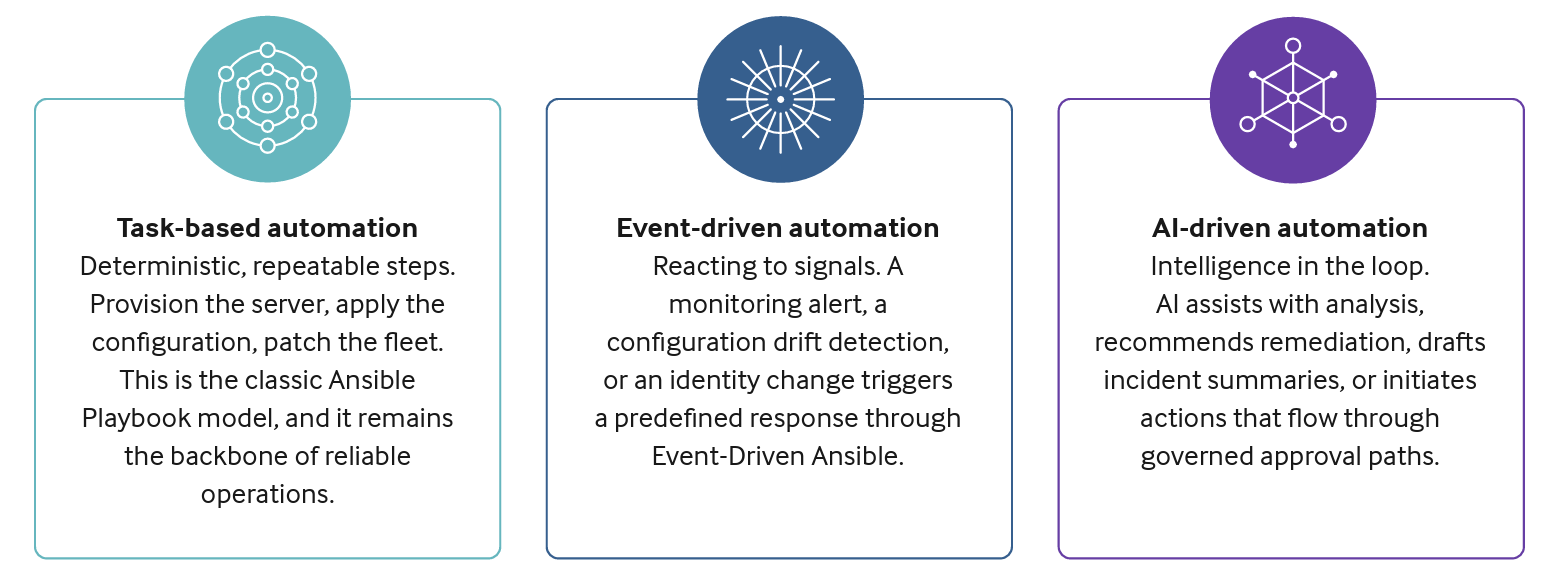
Enterprise automation today operates in three distinct modes:
These are not competing approaches, and treating them as separate tools is exactly how organizations end up with fragmented automation. They work best when they are combined into a seamless process: a security alert arrives as an event, deterministic tasks execute the remediation, and AI summarizes the incident and suggests follow-up actions — all in one workflow, governed under one set of controls.
That’s where an orchestrator comes in.
The automation orchestrator: one canvas, one governance model
Red Hat’s automation orchestrator is a new capability in Ansible Automation Platform — currently in Technology Preview — that lets teams design and manage complex workflows on a single visual canvas with shared data and unified governance. Rather than chaining jobs across scattered scripts and ad hoc integrations, teams model the entire workflow: deterministic steps, event triggers, AI-driven actions, approval gates, and branching logic in one place.
The critical design point is that every action passes through the same role-based access control, approval mechanisms, and audit trail — whether a human, an event, or an AI agent initiated it. Red Hat's framing is deliberate: Ansible Automation Platform becomes the trusted execution layer between intelligence and infrastructure. AI agents can investigate and recommend; execution happens through human-approved, deterministic workflows your organization already trusts.
Because the orchestrator is Technology Preview, it is appropriate for evaluation and workflow design today — not yet for production dependencies. Ansible Automation Platform 2.7 itself ships with immediately usable enhancements: a Model Context Protocol (MCP) server that connects AI tools to automation without custom integrations, an enhanced automation portal for self-service content, ROI metrics in the automation dashboard, and OpenID Connect integration for short-lived, job-scoped credentials.
Why this matters for enterprises
Orchestration changes the economics of automation. When workflows connect across identity, security, cloud, and operations domains, the wins compound:
-
Fewer manual interventions
-
Fewer handoff errors
-
Faster recovery times
-
Complete audit records for compliance.
Just as important, governance scales with ambition. Orchestration isn't only about speed; it's about safe speed. Broader and more intelligent automation demands stronger controls — separation of duties, approval steps, traceability. Teams extend trust to the automation layer incrementally, and the platform earns it with every governed execution.
The use cases are concrete: security orchestration that detects, enriches, isolates, and notifies; infrastructure lifecycle workflows that provision, sync inventory, and validate configuration; compliance remediation that detects drift, applies fixes, and generates the audit record; identity workflows driven by HR or IAM events; and AIOps responses where observability signals trigger remediation and AI drafts the incident summary.
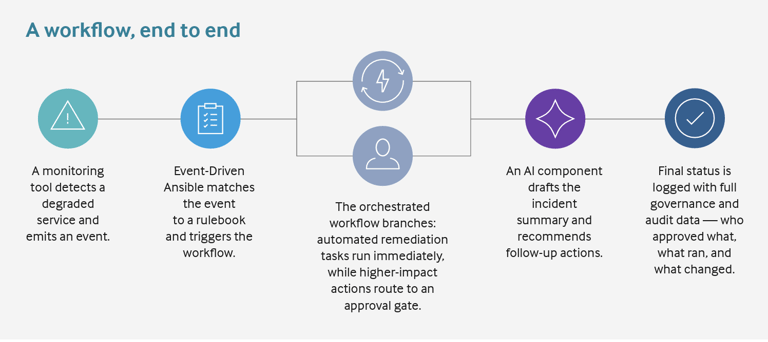
No swivel-chair operations. No tribal knowledge about which script to run next. One workflow, visible to every stakeholder, with controls at every step.
Orchestration isn't only about speed; it's about safe speed. Broader and more intelligent automation demands stronger controls — separation of duties, approval steps, traceability.
How to get started
Start with one high-value workflow that crosses at least two domains — security and infrastructure, or identity and operations. Map it into tasks, events, and decision points before you build anything. Reuse the playbooks you already have; the entire premise of this evolution is that existing automation becomes the governed foundation for what comes next, not technical debt to rewrite. Prove value on the first workflow, then expand incrementally.
And evaluate the automation orchestrator now, while it's in Technology Preview — the teams that have mapped their cross-domain workflows in advance will move fastest when it reaches general availability.
Where IIS fits
IIS Technology Solutions is a Premier Red Hat Partner with a practice built around exactly this challenge — connecting automation across the systems enterprises actually run. Our library of more than 40 pre-built automation modules spans Palo Alto Networks, F5 BIG-IP, Infoblox DDI, and ZScaler, giving cross-domain workflows a running start rather than a blank canvas. We work through a simple engagement model — Understand, Explore, Validate, Implement — so you can prove value on one workflow before committing to a broader rollout.
Sources Red Hat press release, May 12, 2026: “Red Hat Establishes Ansible Automation Platform as the Trusted Execution Layer for IT Operations in an Agentic Era” — redhat.com/en/about/press-releases Red Hat Ansible Automation Platform orchestration overview — redhat.com/en/technologies/management/ansible/orchestration Automation orchestrator product page — redhat.com/technologies/management/ansible/automation-orchestrator
If you're thinking about what multi-mode orchestration could look like in your environment, let's map your first workflow together. Reach us at redhat@iisl.com.
4 IIS Red Hat Practice blog | June 2026
.jpg)