White Paper Summary
Intelligent Automation at Scale: A Four-Stage Journey from AI-Assisted to Autonomous IT Operations
How IIS Technology Solutions leverages HPE Private Cloud AI, Red Hat OpenShift, Ansible Automation Platform, and NVIDIA AI Factory to build progressively more intelligent and autonomous automation workflows.
Automation Alone Isn’t Enough
Every IT organization is under pressure to operate faster, more reliably, and with leaner teams. Automation is the foundational answer—but automation alone only goes as far as the humans who design and trigger it. The next frontier is using AI to make automation smarter, faster, and progressively more self-directed.
IIS Technology Solutions has developed a structured, four-stage approach to building AI-augmented automation on top of an enterprise foundation. The approach is deliberately incremental: organizations start with familiar tools and concrete outcomes, then grow their capability—and their confidence—before moving toward autonomous operations.
The Technology Stack: Foundation First
A critical design principle in the IIS approach is that AI capability is additive—it extends a stable, governed platform rather than replacing it. Organizations that skip the foundation consistently struggle with governance gaps, security debt, and integration failures.
The IIS reference stack is organized in four layers, each dependent on the one beneath it:
| Layer |
Role |
Key Components |
| Infrastructure |
Pre-integrated compute, storage & networking |
HPE ProLiant DL380a (Gen12 / Gen11), HPE GreenLake for File Storage, NVIDIA Spectrum-X |
| Automation Foundation |
Governance, execution & orchestration |
Red Hat AAP 2.6, Event-Driven Ansible, OpenShift Container Platform |
| MLOps Platform |
Model development, training & serving |
Red Hat OpenShift AI (RHOAI), KubeFlow Pipelines |
| GPU-Accelerated Inference |
Production AI model serving |
NVIDIA GPU Operator, NIM, NeMo, vLLM / Triton |
HPE Private Cloud AI: The Infrastructure Substrate
HPE ProLiant GPU servers, HPE GreenLake for File Storage, and NVIDIA Spectrum-X networking are available as pre-integrated infrastructure through HPE Private Cloud AI.
Note: PCAI itself ships with a full AI software stack. The OpenShift-based deployment path in this architecture uses the Red Hat AI Factory with NVIDIA on HPE ProLiant—the same hardware, but with Red Hat OpenShift as the container platform. IIS uses comlimentry technology to work hand in hand with HPE PCAI.
HPE PCAI Offical Site
The Four-Stage Maturity Model
Each stage builds directly on the previous one—no stage is skipped, and each delivers independent business value before the next begins. Human oversight decreases as model confidence and platform governance maturity increase.
| Stage |
Name |
What Changes |
Human Oversight |
| 1 |
Foundation |
AAP deployed; AI assists playbook authoring via Lightspeed. OCP cluster stood up on HPE ProLiant. |
High |
| 2 |
AI-Enabled |
RHOAI + HPE PCAI GPU infrastructure deployed. Models recommend; EDA routes events with human-approval gates. |
Medium |
| 3 |
AI-Driven |
vLLM/NIM on HPE ProLiant GPU infrastructure at production scale. Pre-approved playbooks execute autonomously on AI signal. |
Low |
| 4 |
Autonomous |
NeMo fine-tuning on HPE PCAI GPU nodes + automated KubeFlow retraining. Closed-loop: the system improves itself. |
Minimal |
The transition between Stage 2 and Stage 3 is the most significant governance checkpoint. Before crossing it, organizations must have established AAP RBAC, approved playbook libraries, runbook documentation, and a clear escalation policy. IIS recommends a formal Stage 2 validation before any Stage 3 automation is activated in production.
How Each Stage Works
Stage 1 — Foundation: Governed Automation with AI-Assisted Content
AAP is deployed in Growth or Enterprise topology with OpenShift as the cluster baseline (HPE ProLiant infrastructure recommended for AI-ready sizing). Ansible Lightspeed accelerates playbook development—AI assists the builder, not the runner. Every job template is still reviewed and triggered by a human. IIS delivers platform implementation, an automation opportunity assessment identifying the top 10–15 use cases, Lightspeed enablement, and deployment of applicable modules from the IIS 40+ pre-built content library (Palo Alto, F5, Infoblox, ZScaler).
Stage 2 — AI-Enabled: Model-Informed Decisions
HPE PCAI GPU infrastructure comes online—HPE ProLiant GPU servers, HPE GreenLake for File Storage, and NVIDIA Spectrum-X networking, with the NVIDIA GPU Operator managing device allocation. RHOAI is deployed with KubeFlow Pipelines for model training and serving. Models analyze operational data (infrastructure metrics, log patterns, configuration drift) and surface recommendations. EDA is activated but operates with conditional approval: high-confidence recommendations generate pre-populated ServiceNow incidents that a human reviews before AAP executes.
The key discipline at Stage 2 is model validation. IIS helps establish confidence thresholds, acceptance criteria, and the approval workflow integration before any model output reaches an automation trigger.
Stage 3 — AI-Driven: Autonomous Execution for Pre-Approved Scenarios
The human approval step is removed for a defined, vetted set of automation scenarios. vLLM is promoted to production on HPE ProLiant GPU infrastructure, leveraging Spectrum-X networking for optimal throughput. NVIDIA NIM microservices provide pre-optimized inference endpoints for foundation models. Pre-approved playbooks fire directly when model confidence exceeds the established threshold.
Representative Stage 3 use cases IIS delivers:
| Domain |
Event Source |
Autonomous Action |
| Network Security |
Palo Alto Cortex XSOAR anomalous traffic classification |
AAP triggers policy enforcement; isolates affected segment |
| DNS / DHCP |
Infoblox DDI threshold alert — IP exhaustion predicted |
AAP triggers subnet expansion playbook |
| Load Balancer |
F5 BIG-IP telemetry — pool member health degradation |
AAP triggers pool member drain and failover |
| Cloud Security |
ZScaler policy drift — unauthorized application detected |
AAP triggers ZScaler policy remediation |
| Infrastructure |
Prometheus alert — disk pressure predicted by RHOAI model |
AAP triggers storage cleanup and archival |
Stage 4 — Autonomous: Closed-Loop, Self-Improving Operations
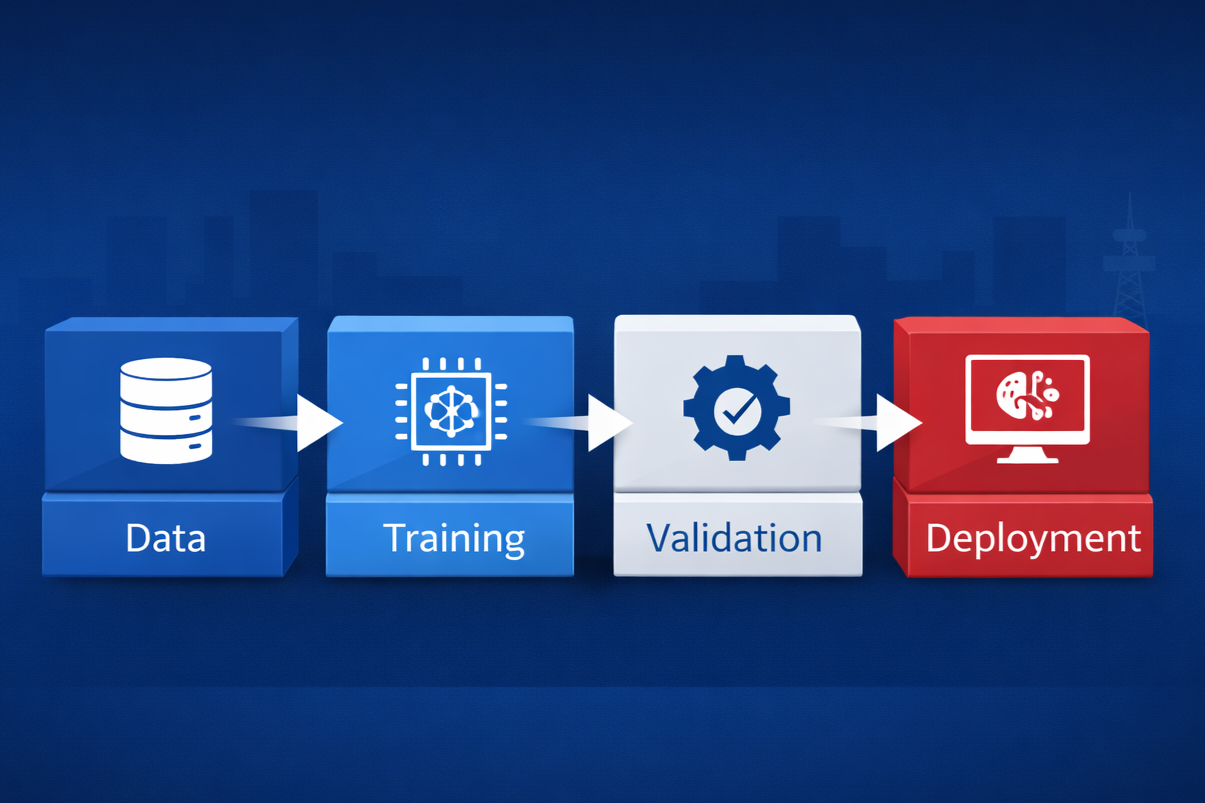
Stage 4 closes the feedback loop. RHOAI model monitoring detects accuracy degradation and triggers automated retraining pipelines in KubeFlow. NVIDIA NeMo handles compute-intensive fine-tuning on HPE PCAI GPU nodes, pulling fresh operational data from HPE GreenLake for File Storage. Retrained models are evaluated against acceptance criteria and—if they pass—automatically promoted to the production serving endpoint. On the automation side, AAP execution telemetry (success rates, failure categorization) is continuously fed back as a training signal, so recommendation quality improves without human curation.
Governance at Stage 4
Autonomous does not mean uncontrolled. Stage 4 requires the most mature governance posture of any stage: automated accuracy, bias, and performance checks in model promotion gates; full traceability from EDA job label through AAP job ID to model inference ID and training dataset version; explicit human escalation paths for every autonomous workflow; and quarterly human review of execution patterns and model behavior drift.
IIS Services: Enter at Any Stage
IIS offers modular services aligned to each stage transition. Customers enter at the stage relevant to their current maturity. Every engagement delivers standalone business value and the documented stage-gate artifacts required before advancing.
| Stage |
IIS Service |
Entry Signal |
| 1 |
AAP Foundation Implementation |
“We need to build our automation foundation” |
| 2 |
AI Platform Foundation (HPE PCAI + RHOAI) |
“We need an ML platform” or “We need GPU infrastructure” |
| 3 |
NVIDIA AI Factory Deployment on HPE PCAI |
“We need faster inference” or “We’re ready for autonomous execution” |
| 4 |
Closed-Loop AI Operations |
“We want the system to improve itself” |
| All |
Automation CoE Advisory |
“We want to build sustainable capability” |
The Bottom Line
The path from assisted to autonomous IT operations is not a single project—it is a multi-stage capability journey that requires a stable foundation, disciplined governance, and incremental confidence-building at each transition. The most durable AI automation environments are those where the humans closest to the infrastructure trust the system, and that trust is earned incrementally.
HPE ProLiant GPU infrastructure—available through HPE Private Cloud AI—provides the pre-integrated hardware foundation. Red Hat OpenShift and AAP provide governance and execution. RHOAI and NVIDIA AI Factory deliver the data science, MLOps, and inference capabilities that make it scalable. IIS brings the delivery expertise, the pre-built content, and the structured methodology to help customers navigate this journey at their own pace.
Begin Your Intelligent Automation Journey
Contact IIS Technology Solutions to schedule an AI-Augmented Automation Readiness Assessment
Contact Us →
redhat@iisl.com | www.iistech.com | Premier Red Hat Partner | ISO 9001 Certified